Saturday, May 23, 2009

Tipaimukh Dam: An alarming venture


TIPAIMUKH dam located in Monipur state of India, by all definitions falls into the category of a large high head [162m] dam. Though learnt to be a hydel power project for generation of 1500 MW electricity, it will definitely work as a flood control dam for Monipur and the neighbouring Mizoram state and irrigation may be practiced in suitable land areas along the 1 km stretch of the Barak river up to the Bangladesh border and by the periphery of the reservoir perimeter.

Dam and international river
Since the river Barak-Surma-Kushyara is an international river, Bangladesh as a lower riparian country should have an equitable share of water and an access to the deign details of the project, planning and design etc. It is learnt that the construction that started in 2007 was halted due to national and international uproar and resistance against probable environmental degradation inside and outside Indian territory and unilateral withdrawal of water of the river which will turn Bangladesh's north-eastern lush-green fertile soil into a sandy dry waste land, during the dry reason.

Such action tantamounts to violation of international convention which controls/regulates the equitable share to water of international rivers/watercourses. The above topics were discussed in many forums in different meetings and seminars in Dhaka and Sylhet and in at least two published books, 'No to Tipaimukh Dam' and 'Controversial Tipaimukh Dam: Overall Review'.

If we have access to the planning and deign details of the dam we can see, apart from hydro-power generation, what else the project entails. Whether it has a component of irrigation in particular, as for irrigation they will use winter dry season flow which otherwise would have been flowing downstream for ecological and other uses in the lower riparian country. For any large dam the release of water in the low flow period for ecological use is mandatory by international convention as well as custom.

Dam Break Study
For every large dam there is an important study called "Dam Break Study". In olden days this study was done by thumb-rule calculation without use of modern technology. In USA dams constructed in the 30's had serious incidences of collapse. Now the computer assembles all study, data and design eriteria to ascertain the stability and strength of the dam against possible break/breach due to some acts of God like catastrophic hydrological events, severe earthquake or other events (like war). Different models are used to determine as to how to minimize high flood damages that might cause death and destruction downstream. In this case Bangladesh will be the poor victim. Tipaimukh dam impounding "billions" of cube meter (M3) of water, will naturally cause catastrophic floods (in case of dam break) for the dam is large and high.

Nigerian experience

The writer has the experience of review and analysis of a Chinese-built large and high dam in Cameroon, Africa, 40km east of Nigerian border on the large Benue river in 1980. In Nigeria its dam break study was performed. Design flood for this large dam was taken as 50,000-year flood. In the high hilly drainage basin of the dam, there was very high rainfall with consequent abnormal rise of water level of the reservoir in 1988 flood season which menacingly threatened the very stability of the dam, with water almost overtopping the dam. It was a rock-fill dam on which overtopping might have resulted in washing away of the dam with catastrophic consequences in both countries.

However, I am citing this grim episode for lessons for Tipaimukh dam design. If we can have an access to its design details, we can verify what flood frequency they had applied to arrive at design flood. As for any faulty design, if any catastrophe occurs, the sad outcome will fall on us in Bangladesh as a result of dam break.

For a dam of such magnitude and dimension a 100,000 to 500,000-year design flood should be considered adequate, particularly when the location of the dam is in a hilly earthquake-prone and a high intensity rain region of India.

Adverse effects
Adverse effects of the Tipaimukh dam will be staggeringly devastating and damaging for Bangladesh. Environmental degradation, economic crisis and hydrological drought will cause irreversible damage. Suddenly, the free flowing Surma and Kushyara rivers will turn dry and remain so for a major portion of the year (Nov-May) disrupting agriculture, irrigation, drinking water supply, navigation etc. Six to seven months dry conditions will stop/lessen recharge of ground water which over the years will lower the ground water level, affecting all dug wells, shallow tubewells, as it happened in south western region of Bangladesh as a result of drastic withdrawal of the Ganges water at Farakka. Agriculture that depends on surface as well as ground water will be affected seriously.

Surma-Kushyara with its maze of numerous tributaries and distributaries support agriculture, irrigation navigation, drinking water supply, fisheries, wildlife in numerous haors and low lying areas in the entire Sylhet division and some peripheral areas of Dhaka division. The river system also supports internal navigation, wildlife in haors, industries like fertilizer, electricity, gas etc.

The rosy, prosperous and healthy scenario may soon turn into history causing despondency desperation and misery to the people inhabiting the zone which is known for abundance of water, lush green field of crops and fish sanctuary.

Massive environmental degradation will occur, drastically affecting weather and climate, turning a wet cooler habitat into a hot uncomfortable cauldron. The severity of micro-climate causing heat and dry conditions will gradually increase in intensity spreading over a large area over the years. It may be mentioned that rainfall that the area gets for 4 to 5 months and flood water that will be released from the dam for a short period will not be enough to replenish the ground water. Climate and environmental change will force the farmers to reluctantly resort to planting low-yielding drought-resistant crops (unknown to them).

Sedimentation
Scarcity of water will cause siltation on river beds. When high rainfall will occur in the catchment area of the dam, enormous quantity of sediment-laden flood water will be released which will cause severity of flood in the Surma and Kushyara channels which would be already raised for low flow. This will further raise the water level causing floods in adjoining additional areas.

Navigation in river channels in the Meghna (combined Surma and Kushyara) will face depleted water flow and consequent sedimentation and severity of flooding in the wet season. Surface irrigation will be in jeopardy. The Meghna up to Chandpur will suffer from the adverse effects. The Meghna-Padma will have low flow which will accentuate saline backwater intrusion in the Padma channel which is already affected by the low flow for the withdrawal of water of the Ganges at Farakka.

Relevant ecological flow
The writer visited Bhumipol and Sirikit Dam sites in Thailand in mid seventy's. Though the dams were completed about 5/6 years ago the reservoir water level did not reach design level and the filling of the reservoir was continuing unabated during dry and rainy seasons. It was ascertained that water flowing (a good per cent of the impoundment) unabated through the outlet meant for release of water to maintain ecological balance in the downstream channel. The writer designed four major dams in Nigeria where, in all of them, there are separate adequate outlets for irrigation, water supply and hydropower and ecological flow for environment and emergency outlet for rapid evacuation of water for the safety of the dam.

It is expected that Tipaimukh dam will also allow ecological flow along with the equitable share of water for the international river Barak-Surma-Kushyara for Bangladesh as per entitlement negotiation.

Conclusion
Our government (JRC) may request India to postpone, better stop the construction of the Tipaimukh Dam if possible, through bi-lateral diplomacy or else seek intervention by United Nations. Sharing of water of Indus basin was negotiated between India and Pakistan with the assistance of the World Bank. A dispute on river Danube between Czechoslovakia later Slovakia and Hungary was referred to the International Court of Justice. In our own country Farakka issue was resolved bilaterally with India.

Our government (JRC) should soon start negotiation on equitable sharing of water according to our entitlement as a lower riparian of the international river Barak-Surma-Kushyara as per UN Convention. Unilateral withdrawal would be a gross violation of UN Convention that regulates the use of water of international rivers/water courses. Any delay in negotiation might end up in a pathetic situation, causing irreversible environmental, economic and hydrological chaos.

We may ask for design/survey data, drawings/maps etc, and EIA report prepared by the dam authority in order to verify if the Dam Break Study was made and whether EIA included adverse effects and mitigation measures thereof for the lower riparian Bangladesh. Environment-concerned institutions and individuals may even intensify resistance against the Tipaimukh Dam, as it is still in the rudimentary stage of constriction.

The writer, a water resources expert, is a professor of civil engineering in the World University of Bangladesh. He was formerly in World Bank, Washington DC, UN/FAO, Nigeria, Planning Commission and BWDB, Dhaka.

[Source : Daily Star Internet Edition ]


Join The Facebook Group - "Protest Against Tipaimukh Dam"


Thursday, February 12, 2009

21st February > International Mother Language Day <

21 February was proclaimed the International Mother Language Day by UNESCO on 17 November 1999. Its observance was also formally recognized by the United Nations General Assembly in its resolution establishing 2008 as the International Year of Languages.

International Mother Language Day originated as the international recognition of Language
Movement Day, which has been commemorated in Bangladesh (formerly East Pakistan) since 1952, when a number of Bangladeshi university students were killed by the then East Pakistan police and army in Dhaka, formerly Dacca.

International Mother Language Day is observed yearly by UNESCO member states and at its
headquarters to promote linguistic and cultural diversity and multilingualism.

History Of the day

On that day of 21 February 1952, corresponding to 8 Falgun 1359 in the Bangla calendar, a
number of students campaigning for the recognition of Bangla as one of the state languages of
Pakistan were killed when police fired upon them.

Mohammed Ali Jinnah(the Governor general of Pakistan) declared that the Urdu will be the
only language for both west and east Pakistan at a public meeting on 1948, 21 March. The
people of the East Pakistan (now Bangladesh, whose main language is Bengali) started to
protest against this.

A student meeting on 21 February called for a province-wide strike. But the government
invoked Section 144 on 20 February. The student community at a meeting on the morning of
21 February agreed to continue with their protest but not to break the law of Section 144.
Even then the police opened fire and killed the students.

Police declared Section 144 which banned any sort of meeting. Defying this, the students of
University of Dhaka and Dhaka Medical College and other political activists started a
procession in February 21, 1952. Near the current Dhaka Medical College Hospital, police
fired on the protesters and numerous people, including Abdus Salam, Rafiq Uddin Ahmed,
Sofiur Rahman, Abul Barkat and Abdul Jabbar, died.

The movement spread to the whole of East Pakistan and the whole province came to a
standstill. Afterwards, the Government of Pakistan relented and gave Bengali equal status as
a national language.

Thursday, September 4, 2008

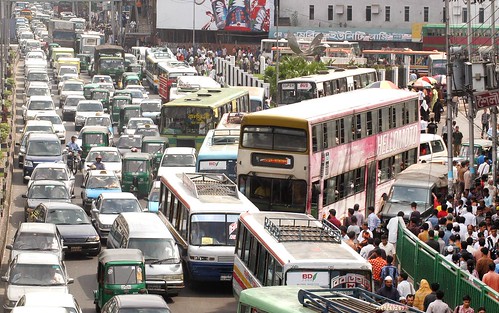
Traffic Jam in Dhaka - Time Killer

Dhaka’s hopeless traffic jams stop everything but the clock!

Dhaka is a City of many different transport modes. On a typical day in Dhaka you might be lucky enough to see many types of animals pulling custom made trailors!
While there is still many Rickshaws you might be surprised to see many vehicles that only suit Roads in the so-called First or Western World.
The Traffic jams would consist of the above transport modes plus your Indian Tata Trucks(Although on many roads Trucks don't operate during day time),Double Deckers,Buses and many MPV type vehicles (also known as liteace in Bangladesh).

If you find your self unfortunate enough to be stuck in one of these jams on a hot and sunny day, make sure you purchase a bottle of Mirinda or some other American tasting soft drink from the street seller who is most likely to be carrying a bucket full of Western influence in a bottle!

By the way, the street sellers in Bangladesh are also know as "Feriwala" in Bengali, although if it's a young kid, you'd normaly call him/her "Pich-chi" as in "Kid".

A soft drink can or bottle isn't very expensive these day's due to rapid Globalization!

And yes, average jams in Dhaka will waste atleast 2 hours, so if your in a rush walk all the way, if you can find any footpaths for pedestrians that is!

But as far as I know, the World Bank thinks that Bangladesh will be a better and organized nation by 2020, so keep your fingers crossed!

Saturday, August 2, 2008

Happy Friend-Ship Day!!


Happy Friendship day on 3rd August

"Friend"...wow...this word itself is so soothing to both the ears and the heart. :) I personally believe that if you are lucky you make somebody your friend, but if you are the luckiest, someone befriends you coz your friend is someone who knows everything about you, and still likes you. Now that's not easy, isnt it?? Its really difficult to know the physical,cultural,characterial limitations of somebody and still accept them and love them for what they are...I am the luckiest to have friends like you who accepted me for what I was and help me become what I am capable of becoming.

Herez something interesting for all of you :

Friendship Recipe
1 Cup of Friendly Words
2 Heaping Cups of Understanding
4 Heaping Tsp. of Time and Patience
A Pinch of Warm Personality
A Dash of Humor

Measure Words Carefully.
Add Heaping Cup Of Understanding.
Use Generous Amounts Of Time And Patience.
Cook On The Front Burner
But Keep Temperature Low: Do Not Boil.
Add Generous Dash Of Humor
And A Pinch Of Warm Personality.
Season To Taste With Spice Of Life.
Serve In Individual Molds.

'The only way to have a friend is to be one'
- Adham Rahman

Sunday, May 4, 2008

The world biggest subsea robot

According to a newspaper of Newcastle upon Tyne, UK, companies installing subsea cables for telecommunications companies and pipelines for the oil industry have now a new tool, the Ut-1 Ultra Trencher which is the world's biggest subsea robot. This beauty weighs 60 tons (in the air) and has a length of 7.8 meters, a width of 7.8 meters and a height of 5.6 meters. In fact, it has the dimensions of a small house but is more expensive, carrying a price tag of about £10 millions. It can move at a speed of 2 to 3 knots under the sea. And it can trench pipelines with a 1-meter diameter in deep waters of up to 1,500 meters. But read more...

The UT-1 Ultra Trencher

Here is what the UT-1 Ultra Trencher looks like. This huge subsea robot has been built by, Soil Machine Dynamics (SMD) a Newcastle upon Tyne company which develops specialized remote controlled submersible robots (ROVs).

The first UT-1 Ultra Trencher has been delivered to CTC Marine Projects, a subsea contractor, based in North East of England, UK, and a subsidiary of DeepOcean, a norwegian company focused on subsea services. This submarine robot will be permanently installed on one of their new vessels, the Volantis (PDF format, 6 pages, 764 KB).

Here is a short excerpt from the Henderson article. "Weighing 50 tonnes and the size of small house, it is designed to bury largediameter oil and gas pipelines laid on the ocean floor. It does this by 'flying' down up to a mile deep below the surface using powerful propellers. It then lands over the pipeline and deploys a pair of 'jet swords' either side of the pipe which inject high pressure water to 'fluidise' the surface. Burying the pipelines protects them from fishing, shipwrecks and natural currents. This enables oil and gas to be safely transported from the offshore fields to land to provide secure energy supplies."

For more information, you'll find the complete specifications of the UT-1 Ultra Trencher in this PDF datasheet (2 pages, 917 KB), from which the above illustration has been extracted.

Here is a short excerpt. "The UT-1 Ultra Trencher�is the world's most powerful jetting trencher, offering unparalleled flexibility in severe weather deployment and operation. With more than 2 megawatts of total power, the trencher delivers 1.5 megawatts of actual jetting energy to the cutting surface."

Friday, April 25, 2008

Mikoyan MiG-29 'Fulcrum'


Mikoyan MiG-29 'Fulcrum'

The history of the MiG-29 (Russian: МиГ-29), like that of the larger Sukhoi Su-27, started in 1969 when the Soviet Union learned of the U.S. Air Force’s 'FX' program, which resulted in the F-111 Aardvark, and later the F-14 Tomcat. The MiG-21 was agile by the standards of its day, but had deficiencies in range, armament, and growth potential. The MiG-23, developed to match the F-4 Phantom II, was fast and had more space for fuel and equipment, but lacked in maneuverability and dogfighting ability. In response, the Soviet General Staff issued a requirement for a Perspektivnyy Frontovoy Istrebitel (PFI, roughly "Advanced Frontline Fighter", literally "Perspective Frontline Fighter"). Specifications were extremely ambitious, calling for long range, good short-field performance (including the ability to use austere runways), excellent agility, Mach 2+ speed, and heavy armament. The aerodynamic design for the new aircraft was largely carried out by TsAGI, the Russian aerodynamics institute, in collaboration with the Sukhoi design bureau.


Mikoyan MiG-29 'Fulcrum'

However, in 1971 the Soviets determined that the PFI aircraft would be too expensive to procure in the quantities needed, and divided the requirement into the TPFI (Tyazhyolyy Perspektivnyy Frontovoy Istrebitel, "Heavy Advanced Tactical Fighter") and the LPFI (Lyogkiy Perspektivnyy Frontovoy Istrebitel, "Lightweight Advanced Tactical Fighter") programs, the latter paralleling the contemporary USAF decision that led to the "Lightweight Fighter" program and the F-16 Fighting Falcon and YF-17 Cobra. Despite program delays caused by the loss of two prototypes in engine-related accidents, the MiG-29B production version entered service in August 1983 at the Kubinka air base
In the West, the new fighter was given the NATO reporting name "Fulcrum-A" because the pre-production MiG-29A, which should have logically received this designation, remained unknown in the West at that time.
Refined versions of the MiG-29 with improved avionics were fielded by the Soviet Union, but Mikoyan's multi-role variants, including a carrier-based version designated MiG-29K, were never produced in large numbers. In the post-Soviet era, MiG-29 development was frustrated by the Mikoyan bureau's apparent lack of political clout compared to rival Sukhoi. Some more advanced versions are still being pursued for export, and updates of existing Russian aircraft are likely. New versions of the plane called MiG-29SMT and MiG-29M1/M2 are being developed. Furthermore, development of a carrier version, the MiG-29K, has been resumed for the Indian Navy's INS Vikramaditya aircraft carrier (formerly the Russian aircraft carrier Admiral Gorshkov).

Mikoyan MiG-29 'Fulcrum'


The MiG-29 was first publicly seen in the West during a visit to Finland in July 1986. Two were displayed at the Farnborough Air Show in Britain in September 1988. The following year, the aircraft conducted flying displays at the 1989 Paris Air Show where it was involved in a non-fatal crash during the first weekend of the show.
MiG-29s of the German Luftwaffe participated in a joint DACT exercise with the US 510th Fighter Squadron who used F-16 fighters. As a result of the exercise, the F-16 pilots described the MiG's greatest strengths as "its thrust (the plane has two engines to the F-16's one), the Archer heat-seeking air-to-air missile system and the HMS". The success of the MiG-29 during DACT was partly due to its ability to use its helmet-mounted sight (HMS) to achieve high off-boresight targeting solutions for the Archer missile. In 1997, the United States purchased 21 Moldovan aircraft for evaluation and analysis. In late 1997, the MiGs were delivered to the National Air Intelligence Center (NAIC) at Wright-Patterson Air Force Base.
Because it was developed from the same basic parameters laid out by TsAGI for the original PFI, the MiG-29 is aerodynamically broadly similar to the Sukhoi Su-27, but with some notable differences. It is built largely out of aluminium with some composite materials. It has a mid-mounted swept wing with blended leading-edge root extensions (LERXs) swept at around 40°. There are swept tailplanes and two vertical fins, mounted on booms outboard of the engines. Automatic slats are mounted on the leading edges of the wings; they are four-segment on early models and five-segment on some later variants. On the trailing edge, there are maneuvering flaps and wingtip ailerons.

Mikoyan MiG-29 'Fulcrum'

The MiG-29 has hydraulic controls and a SAU-451 three-axis autopilot but, unlike the Su-27, does not have a fly-by-wire control system. Nonetheless, it is very agile, with excellent instantaneous and sustained turn performance, high alpha capability, and a general resistance to spins. The airframe is stressed for 9-g (88 m/s²) maneuvers. The controls have "soft" limiters to prevent the pilot from exceeding the g and alpha limits, but these can be disabled manually.
The MiG-29 has two widely spaced Klimov RD-33 turbofan engines, each rated at 50.0 kN (11,240 lb) dry and 81.3 kN (18,277 lb) in afterburner. The space between the engines generates lift, thereby reducing effective wing loading, to improve maneuverability. The engines are fed through wedge-type intakes fitted under the LERXs, which have variable ramps to allow high-Mach speeds. As an adaptation to rough-field operations, they can be closed completely for takeoff, landing and low-speed flying, thereby preventing ingestion of ground debris.
The internal fuel capacity of the original MiG-29B is only 4,365 liters distributed between six fuel tanks, four in the fuselage and one in each wing. As a result, the aircraft has a very limited range in line with the original Soviet requirements for a point-defense fighter. For longer flights, this can be supplemented by a 1,500 liter drop tank carried on the centerline and, on later production batches, by two underwing drop tanks, each capable of 1,150 liters. The pilot is seated on a Zvezda K-36DM zero-zero ejection seat which has had impressive performance in emergency escapes.

Mikoyan MiG-29 'Fulcrum'

The baseline MiG-29B has a Phazotron RLPK-29 (Radiolokatsyonnui Pritselnui Kompleks) radar attack system which includes the coherent pulse-Doppler N019 (Sapfir 29; NATO reporting name 'Slot Back') look-down/shoot-down coherent pulse-Doppler radar and a Ts100.02-02 digital computer.
he latest upgraded aircraft offer the N-010 Zhuk-M, which has a planar array antenna rather than a dish, improving range, and a much superior processing ability, with multiple target engagement capability and compatibility with the Vympel R-77 (or RVV-AE) (NATO reporting name AA-12 'Adder') air-to-air missile. A useful feature the MiG-29 shares with the Su-27 is the S-31E2 KOLS, a combined laser rangefinder and IRST in an 'eyeball' mount forward of the cockpit canopy. This can be slaved to the radar or used independently, and provides exceptional gun-laying accuracy.
Armament for the MiG-29 includes a single GSh-30-1 30 mm cannon in the port wing root. Three pylons are provided under each wing (four in some variants), for a total of six (or eight). The inboard pylons can carry either a 1,150 liter (300 US gallon) fuel tank, one R-27 (AA-10 'Alamo') medium-range air-to-air missile, or unguided bombs or rockets. Some Soviet aircraft could carry a single nuclear bomb on the port inboard station. The outer pylons usually carry R-73 (AA-11 'Archer') dogfight missiles, although some users still retain the older R-60 (AA-8 'Aphid'). A single 1,500 liter tank can be fitted to the centerline, between the engines, for ferry flights, but this position is not used for combat stores. The original MiG-29B can carry general-purpose bombs and unguided rocket pods, but not precision-guided munitions. Upgraded models have provision for laser-guided and electro-optical bombs, as well as air-to-surface missiles.

Mikoyan MiG-29 'Fulcrum' 3 views

Specifications:

Crew: One
Length: 17.37 m (57 ft)
Wingspan: 11.4 m (37 ft 3 in)
Height: 4.73 m (15 ft 6 in)
Wing area: 38 m² (409 ft²)

Empty weight: 11,000 kg (24,250 lb)
Loaded weight: 16,800 kg (37,000 lb)
Max takeoff weight: 21,000 kg (46,300 lb)

Powerplant: 2× Klimov RD-33 afterburning turbofans, 8300 kgf (approximate 81.4 kN) each

Performance:
Maximum speed: Mach 2.3 - 2,445 km/h (1,518 mph)
Range: 700 km combat, 2,900 km ferry (430 mi / 1,800 mi)
Service ceiling: 18,013 m / 59 060 ft (59,100 ft)
Rate of climb: 330 m/s (65,000 ft/min)
Wing loading: 442 kg/m² (90.5 lb/ft²)
Thrust/weight: 1.13

Armament:
1x 30 mm GSh-30-1 cannon with 150 rounds
Up to 3,500 kg (7,720 lb) of weapons including 6 air-to-air missiles — a mix of semi-active radar homing (SARH) and AA-8 'Aphid', AA-10 'Alamo', AA-11 'Archer', AA-12 'Adder', FAB 500-M62, FAB-1000, TN-100, ECM Pods, S-24, AS-12, AS-14.

Avionics:
Phazotron N-109 radar

Mig-29 Video

What is future of Exploration?


Black smoke belches out of a grinding old engine as it hauls Russia's latest Soyuz space capsule across a Kazakh wasteland, while armed guards keep watch. This mixture of high and low technology is probably the future of space exploration, as resources get scarcer and more small governments and independent operators get into the space game. More images of Soyuz in the wasteland, and its launch to the International Space Station, below:

A Russian police officer guards the Russian Soyuz TMA-12 space ship that will carry a new crew to the international space station as the rocket is transported to the launch pad at the Baikonur Cosmodrome, Kazakhstan, Sunday, April 6, 2008. The rocket is scheduled to blast off on Tuesday, April 8. (AP Photo/Dmitry Lovetsky)

Russian police officers guard the Russian Soyuz TMA-12 space ship that will carry a new crew to the international space station as the rocket is transported to the launch pad at the Baikonur Cosmodrome, Kazakhstan, Sunday, April 6, 2008. The mission is expected to ferry two Russian cosmonauts and a South Korean graduate student to the International Space Station. The rocket is scheduled to blast off on Tuesday, April 8. (AP Photo/Dmitry Lovetsky)

Related Posts with Thumbnails